

A landmark moment for lung cancer screening in Australia
July 2025 saw the launch of the Australian National Lung Cancer Screening Program (NLCSP).1 This represented years of concerted efforts by experts and advocates – including consumers – to deliver a screening programme with equity at its core.
The NLCSP aims to detect lung cancer earlier among people at highest risk, in response to concerning data on lung cancer incidence and mortality.1 In 2025, lung cancer was the fifth most common type of cancer diagnosed and was the leading cause of cancer-related deaths in Australia.1 It is hoped that the NLCSP will significantly improve this picture.
The road to decision: establishing the national programme
In August 2019, at the request of the Australian government, Cancer Australia initiated an enquiry into the prospects, process and delivery of a national lung cancer screening programme. A broad spectrum of stakeholders were engaged, including people with lived experience, Aboriginal and Torres Strait Islander peoples, health professionals, researchers and organisations representing diverse stakeholder groups.2 3
The enquiry provided a comprehensive evidence base for lung cancer screening, evaluated its cost effectiveness, and identified an approach most suitable for Australia’s health policy context, outlining implementation pathways.* 3
Building on the results of the enquiry, the Australia Government Department of Health, Disability and Ageing worked with Cancer Australia to explore the feasibility of a national lung cancer screening programme, considering elements such as workforce requirements and infrastructure capacity for low-dose computed tomography (LDCT) screening. A formal application was then submitted to the Medical Services Advisory Committee (MSAC).2-4 In October 2022, the MSAC provided support for the proposal, and a formal announcement of the NLCSP by the Minister for Health and Ageing followed in May 2023.2
Designing and implementing the NLCSP
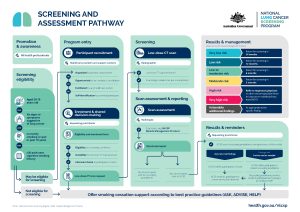
Figure 1. Screening and assessment pathway for the NLCSP (Source: Australian Department of Health, Disability and Ageing. 2025. https://www.health.gov.au/ resources/publications/nlcsp-screening-assessment-pathway). Reproduced with permission.
To guide the design and implementation of the NLCSP, two advisory committees were established:1 4
- Program Advisory Group, an intergovernmental body that included representatives from all jurisdictions to offer policy and programme guidance on implementation
- Expert Advisory Committee, a multidisciplinary group that offered expert guidance on the design and delivery of the NLCSP.
The NLCSP’s implementation was shaped by seven key areas of activity, ensuring a coordinated and equitable approach: partnerships, access, clinical protocols, legislation, registry integration, communications and governance.2 4
The implementation of the NLCSP was led by the Australia Government Department of Health, Disability and Ageing in collaboration with Cancer Australia and the National Aboriginal Community Controlled Health Organisation (NACCHO). The NLCSP aims to remove financial barriers, support clinical delivery and engage communities through tailored messaging.2 4
The NLCSP provides comprehensive information for all health providers involved in the screening and assessment pathway, as well as information for participants, to support seamless implementation. The screening and assessment pathway defines the structure of the NLCSP.
The NLCSP is delivered in four steps:5
- Eligibility: a healthcare provider considers age and pack-year smoking history, and confirms that the person is asymptomatic
- Programme entry: eligible participants who consent to screening for lung cancer receive a referral for an LDCT scan
- Screening: the person attends a radiology provider for an LDCT scan at a fixed site, or a mobile screening service in some rural or remote areas
- Assessment and results: healthcare professionals are informed of the results. Scan results are reviewed by a radiologist and entered into the National Cancer Screening Register (NCSR), which also sends reminders and updates to participants.
Depending on the findings, people may be advised to return for follow-up scans in three, six or 12 months, or continue biennial screening.1 If findings are designated high risk or very high risk, the person will be referred to a specialist linked to a multidisciplinary team for further investigation.1 The enhanced follow-up stage is important, because early intervention can significantly improve outcomes, reduce unnecessary procedures, and ensure that resources are directed where they are most needed.
Ensuring equitable access
Equitable access is at the core of the NLCSP. In the design phase, the central focus was fostering equitable outcomes, particularly for Aboriginal and Torres Strait Islander peoples and other priority populations disproportionately affected by lung cancer.1
Through co-design with NACCHO, the NLCSP has developed tailored information and education resources, culturally appropriate clinical protocols, and customised communication and training materials.6
Looking to the future
Ensuring high-quality delivery, safety and continuous improvement is central to the ongoing implementation of the NLCSP.
A comprehensive quality framework is being established to guide how the NLCSP is measured, monitored and evaluated. This framework will define the NLCSP’s quality principles and standards, outline performance indicators, and set processes for managing safety and quality concerns.2 A data dictionary has been published by the Australian Institute of Health and Welfare (AIHW) with the aim of ensuring that people who collect, provide and analyse data are aligned on terminology.7
A formal review will take place within the first two years of implementation; it will aim to assess the NLCSP’s effectiveness and delivery model.2 The AIHW will be responsible for monitoring and reporting, including publishing annual monitoring reports; the first report is expected in June 2027.2 A Quality Improvement Program plan will also be developed to support ongoing enhancement of the NLCSP.2
Research will play a key role in shaping the NLCSP’s future.2 This includes incorporating research findings into its current practices, integrating innovative technologies once available, and updating clinical guidance as insight into the NLCSP’s practical implementation is gained.2
Recent news



References
Australian Government Department of Health and Aged Care. 2025. About the National Lung Cancer Screening Program. Available from: https://www.health.gov.au/our-work/nlcsp/about [Accessed 06/10/2025]
Australian Government Department of Health and Aged Care. 2025. Establishing the National Lung Cancer Screening Program. Available from: https://www.health.gov.au/our-work/nlcsp/establishing-program [Accessed 06/10/2025]
Cancer Australia. 2020. REPORT ON THE LUNG CANCER SCREENING ENQUIRY. Surry Hills, Sydney
Lung Cancer Policy Network. 2024. Webinar explores the state of lung cancer screening in Asia Pacific. Available from: https://www.lungcancerpolicynetwork.com/webinar-explores-the-state-of-lung-cancer-screening-in-asia-pacific/ [Accessed 10/10/2025]
Australian Government Department of Health and Aged Care. 2025. How the National Lung Cancer Screening Program works. Available from: https://www.health.gov.au/our-work/nlcsp/how-it-works [Accessed 06/10/2025]
Australian Government Department of Health and Aged Care. 2025. Lung cancer screening information for First Nations people. Available from: https://www.health.gov.au/our-work/nlcsp/first-nations#codesigning-the-program [Accessed 06/10/2025]
Australian Institute of Health and Welfare. 2025. National Lung Cancer Screening Program data dictionary: version 1.0.