
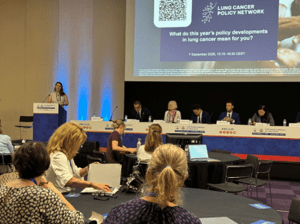
At the World Conference on Lung Cancer in Barcelona, the Network hosted a very well-attended panel discussion focusing on the latest developments in lung cancer policy. The panellists explored how those new initiatives can be leveraged to drive stronger national and regional commitments to improve outcomes in lung cancer. The conference was the latest event in an important year for the lung cancer community, which saw the launch of the IASLC–Lancet Commission on Lung Cancer; publication of a new IASLC report on lung cancer; the adoption of an integrated resolution on lung health at the World Health Assembly; and a consensus statement on lung cancer in the Asia-Pacific region.
Our panel members were:
- Professor Andreas Charalambous, Cyprus University of Technology, University of Turku and IASLC Global Policy and Partnerships Committee
- Dr Xiaoshuang Feng, International Agency for Research on Cancer
- Professor Herbert Loong, The Chinese University of Hong Kong and the Asia Pacific Coalition Against Lung Cancer
- Dr Mary Bussell, TriMar Strategies
- Dr Yannick Romero, Union for International Cancer Control
- Dr Mahdi Sheikh, International Agency for Research on Cancer and IASLC Tobacco Control and Smoking Cessation Committee
The panellists and audience members engaged in a lively discussion centred around several topics.
Lung cancer screening and early detection
The panel cited earlier detection as one of the most powerful approaches to improving outcomes, with screening being a cost-effective way to achieve this. Prof. Loong noted that screening is critical in health systems where budgets and infrastructure impede access to some treatments for late-stage disease. Dr Sheikh in turn emphasised the importance of integrating evidence-based smoking-cessation interventions into screening programmes; studies have shown that this approach increases both the cost-effectiveness and the overall impact of screening.
The upcoming IARC Handbook on lung cancer screening will be an important tool to help drive implementation, supported by national cancer control plans (NCCPs). The panel saw NCCPs as a cornerstone of policy; they advocated for better inclusion of lung cancer and earlier detection – as well as funding commitments – in such plans.
Dr Yannik Romero
Stigma and person-centred care
 The panel discussed stigma as a persistent barrier to progress. Both audience members and speakers shared how they try to address this issue, particularly by being mindful in the words they use when talking about lung cancer.
Dr Romero noted that the language in the lung health resolution was chosen specifically to confront the stigma associated with tobacco use, and that the resolution’s focus on multiple lung conditions was intended to destigmatise lung cancer. The recently updated IASLC Language Guide was also being referenced when discussing the most appropriate language to communicate about lung cancer.
Multi-stakeholder collaboration
Panellists stressed the importance of using inclusive, multi-stakeholder approaches to driving health system change; the Australian screening programme was shared as an example of this type of approach. Such approaches illustrate the benefits of bringing together experts and advocates, and combining the power of clinical and cost-effectiveness data with real-life experiences of people living with lung cancer to design the most appropriate interventions.
Sustainable health systems
The discussion also touched on resource-stratified approaches that reflect local populations, health systems and infrastructure, with programmes designed accordingly. Integrating lung cancer screening into broader oncology prevention strategies was encouraged, with South Korea’s national programme cited as a model. These approaches are essential to reduce risk, achieve earlier detection and diagnosis, and improve care.
Turning evidence into action
A clear message emerged from the discussion – international commitments must lead to regional and national action.
Our speakers were united in their call to action: collective action and practical tools will help us turn global momentum into lasting and transformative lung cancer policies.
We thank our panellists and audience members who joined the discussion and shared their valuable insights. To re-watch the panel in full, please visit the WCLC website.