
About the toolkit
The Network has developed this screening implementation toolkit to support those involved in the planning and delivery of lung cancer screening programmes around the world. It is designed to encourage those applying the Network’s screening implementation framework to take a health systems readiness approach, recognising that while not all health systems will be fully ready to implement lung cancer screening, this should not delay planning.
Within this toolkit, you can find out more about using the framework, and the six domains that it is divided into. You can also access a suite of supporting materials by exploring the individual domain pages and the resources library.
As the implementation of targeted screening programmes using low-dose computed tomography (LDCT) gains pace, it is essential to optimise these programmes to ensure that they have an impact on population health. We hope this toolkit will help ensure that implementation is both feasible and geared for success.
Domains
-
Domain 1: Governance
-
Domain 2: Workforce and technical capacity
-
Domain 3: Financial planning
-
Domain 4: Eligibility and recruitment
-
Domain 5: LDCT screening delivery
-
Domain 6: Data monitoring and evaluation
Domain 1: Governance
Domain 1: Governance

Domain 1 serves as the starting point for those looking to implement a lung cancer screening programme. It supports the evaluation of governing policy context, stakeholder engagement, and programme governance and coordination. The successful implementation of a screening programme is reliant on a solid understanding of the existing policies and guidelines on cancer management and a clear strategy around responsibility for each stage of the process.
Click here to download a policy brief focused on governance.
Domain 2: Workforce and technical capacity
Domain 2: Workforce and technical capacity

Domain 2 requires users to look closely at the professionals involved in delivering a lung cancer screening programme. It helps them consider the current workforce and technical capacity to support the implementation of this programme. They can then determine whether additional staff, equipment or technical innovations are necessary.
Click here to download a policy brief focused on workforce and technical capacity.
Domain 3: Financial planning
Domain 3: Financial planning

Domain 3 helps with the development of a comprehensive budget, considering the anticipated costs of screening implementation and the options for financing the programme. Those responsible for implementation will also need to consider whether any associated costs will be covered for participants, particularly those who risk exclusion due to facing barriers to healthcare access.
Click here to download a policy brief focused on financial planning.
Domain 4: Eligibility and recruitment
Domain 4: Eligibility and recruitment

Domain 4 moves on to consider who will be eligible to participate in the screening programme once it has been implemented. Alongside defining the eligibility criteria and the recruitment process, those implementing the programme will need to think about how to engage the target population and ensure that these individuals have enough information to make an informed decision on taking part.
Click here to download a policy brief focused on eligibility and recruitment.
Domain 5: LDCT screening delivery
Domain 5: LDCT screening delivery

Domain 5 covers the delivery of LDCT screening, supporting the assessment of appropriate screening protocols and parameters to ensure quality and safety. As part of this assessment, those implementing the screening programme should consider how it can combine with other interventions, such as smoking cessation, and how it can be integrated into other aspects of care.
Click here to download a policy brief focused on developing a clear protocol for LDCT screening.
Domain 6: Data monitoring and evaluation
Domain 6: Data monitoring and evaluation

Domain 6 aims to help users determine what data they need to support implementation, as well as how to collect, standardise, share and use them. Users will also find this domain useful in establishing benchmarks against which to evaluate the impact of the programme on population health.
Download our framework to support the implementation of LDCT lung cancer screening
Download

Learn more about the screening implementation framework
The framework was developed based on a review of existing literature, expert interviews and insights from Network members. It was refined through application to five countries where implementation has already taken place: Canada, Poland, South Korea, the UK and the US.
The framework is organised into six domains, each consisting of a series of metrics. The metrics help assess whether key requirements for screening are in place and identify gaps that may need addressing.
Technical guidance and other resources are provided throughout the framework itself and across this online toolkit.

Organising workshops to advance lung cancer screening
Workshops can help advance lung cancer screening by fostering collaboration and shared learning, empowering stakeholders to turn policy into progress.
Built on the Network’s evidence-based screening implementation toolkit, the guide provides practical steps for organising workshops, engaging stakeholders and tailoring activities to local contexts. It covers the full workshop lifecycle – from defining objectives and building an agenda to facilitating discussions and reflecting on outcomes – ensuring participants work collaboratively and apply a systems-based approach to addressing challenges and driving progress in lung cancer screening.

What does health system readiness for a lung cancer screening programme look like?
System readiness refers to the ability of a health system to rapidly and sustainably adapt policies, processes and infrastructure to support the integration of new components of care.
Some countries will have certain components in place with others still in development. Other countries will have regions that are more ready than others, calling for a stepwise roll-out over time. In all scenarios, adopting a systems approach to assessing readiness can help ensure that implementation is successful.
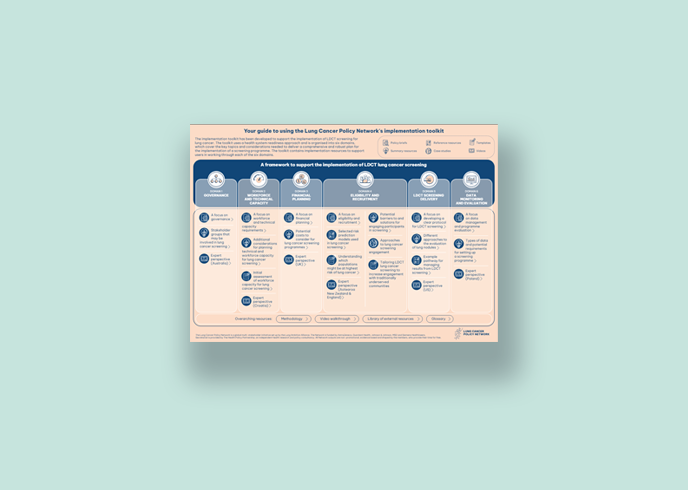
Implementation toolkit guide
This toolkit summary has been developed to support users in applying the implementation framework in their regional context.
The implementation toolkit contains many resources including case studies, templates and summary resources aligned to each domain of the implementation framework and this resource summarises what is available for teams.