Your questions answered
Home » Blog
Blog
Whether you are new to IPNs or planning a programme to manage them, we’re answering some of the most common questions about IPNs. Learn about why managing IPNs effectively can lead to earlier lung cancer diagnoses and what good management looks like.
We speak to Florian Cyril Mshanga, cancer advocate and Founder of the Feliciana Mshanga Memorial Cancer Foundation, about lung cancer in Tanzania and the importance of African voices in global policy.
To shift from political recognition to measurable improvement for patients, countries need to adopt an implementation‑oriented approach.
There is plenty of evidence that earlier detection and better‑coordinated care pathways can dramatically improve survival, reduce costs and improve quality of life.
We spoke to Morten Quist, Senior Researcher Copenhagen University Hospital, and Department of Public Health, University of Copenhagen; Physiotherapist University Hospitals’ Centre for Health Sciences Research (UCSF).
We spoke to Katy Tong Tin Fung, Patient Advocate and Patient Engagement Manager of Cancerinformation.com.hk, Hong Kong.
The path forward for lung cancer screening across Africa is clear: set an ambitious vision for early detection, but accompany it with pragmatic, context-specific steps.
The focus now is on creating a clear pathway from policy to action, ensuring that political commitments translate into real-world impact.
Lung cancer is a leading cause of deaths due to cancer worldwide, and its impact is particularly severe in low- and middle-income countries (LMICs).
Policy alone isn’t enough. Real change happens when global frameworks drive local innovation, and when lessons from communities shape global strategies. Equity, collaboration, and evidence-based action are essential to ensure no one is left behind.
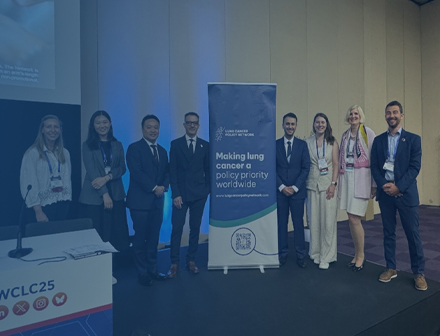
At the World Conference on Lung Cancer in Barcelona, the Network hosted a very well-attended panel discussion focusing on the latest developments in lung cancer policy.
This guest blog from ASPIRE for Lung Cancer explores their recent work to develop a regional consensus statement on lung cancer in Asia Pacific.
This website uses cookies so that we can provide you with the best user experience possible. Cookie information is stored in your browser and performs functions such as recognising you when you return to our website and helping our team to understand which sections of the website you find most interesting and useful.
Strictly Necessary Cookie should be enabled at all times so that we can save your preferences for cookie settings.
This website uses the following additional cookies:
Google Analytics to collect anonymous information such as the number of visitors to the site, and the most popular pages.
Keeping this cookie enabled helps us to improve our website.
More information about our <a href="/privacy-policy/" target="_blank" rel="noopener">Data Privacy Policy</a>.